
Guide to Snapchat Planets 2026: Order and Meanings
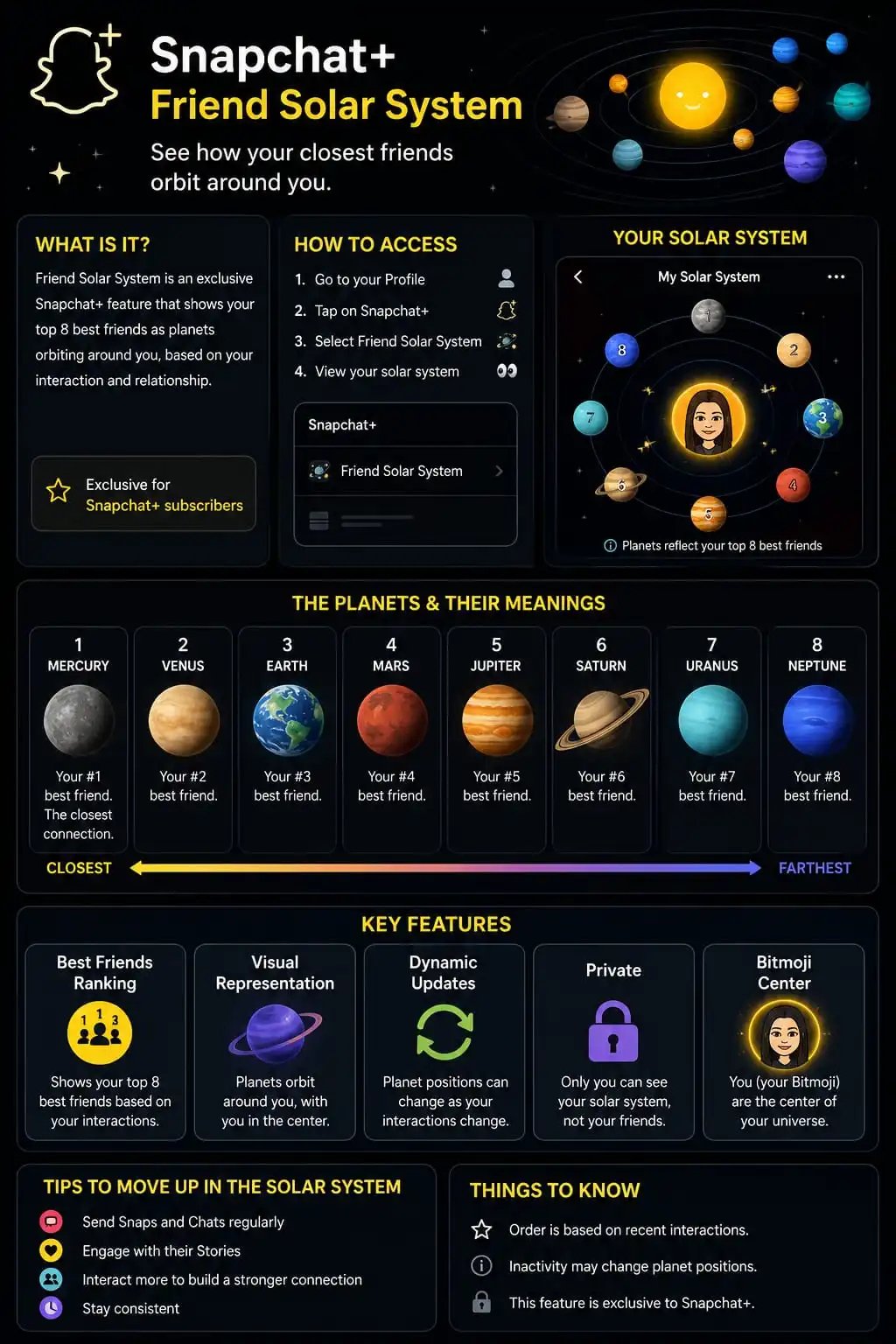
Snapchat Planets is an exclusive Snapchat+ feature known as the Friend Solar System, designed to visualize your closest friendships through a space-themed ranking system. In this feature, you are represented as the Sun, while your top eight friends appear as planets arranged from Mercury to Neptune based on the strength of your interactions. These rankings are determined by factors such as Snaps exchanged, chat activity, story engagement, and streak consistency. The closer a planet is to the Sun, the stronger your connection with that friend on Snapchat.
The Snapchat Solar System provides an easy and entertaining way to understand your friendship rankings within the app. Mercury represents your most interacted-with friend, while Neptune indicates the eighth position among your closest connections. By tapping the planet badge on a friend’s profile, Snapchat+ subscribers can view their position in that person’s friendship orbit. Combining real engagement data with a visually appealing design, Snapchat Planets helps users explore their social relationships and better understand how their interactions influence friendship rankings on the platform.
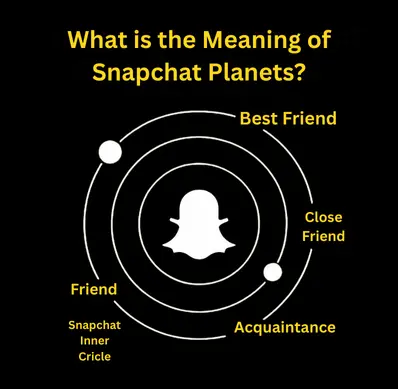
What is the Meaning of Snapchat Planets?
Snapchat Planets is a premium Snapchat+ feature that transforms friendship rankings into a virtual solar system known as the Friend Solar System. In this interactive experience, you are represented as the Sun, while your top eight friends are assigned planets based on the frequency and consistency of your interactions. Snapchat analyzes factors such as Snaps, chats, story reactions, and streak activity to determine each friend’s position. The closer a planet appears to the Sun, the stronger your connection with that person. For example, Mercury represents your closest Snapchat friend, while Neptune indicates the eighth position among your most active friendships.
Unlike a traditional Best Friends list, Snapchat Planets offers a visually engaging way to understand relationship rankings within the app. By opening a Friendship Profile and tapping the Friends or Best Friends badge, Snapchat+ subscribers can view their placement in a friend’s solar system. Each planet reflects a different level of interaction, making it easy to see where you stand without revealing the positions of other friends. This dynamic feature updates as engagement patterns change, creating a personalized snapshot of your closest connections while adding a fun and interactive layer to the Snapchat experience.
How Snapchat Planet System Works
Snapchat Planets, also known as the Friend Solar System, is a Snapchat+ feature that visually represents your friendship rankings using a space-themed system. In this setup, you are positioned as the Sun, while your top eight friends are assigned planets from Mercury to Neptune based on how frequently you interact with them. Snapchat evaluates engagement signals such as Snaps, chats, story replies, streak activity, and overall communication patterns to determine each friend’s position. The more you interact with someone, the closer their planet appears to your Sun, while reduced interaction causes their ranking to move farther away. Mercury represents your most active and closest friend, whereas Neptune reflects your eighth closest connection. This system is dynamic, meaning rankings automatically update as your interaction habits change over time.
To use Snapchat Planets, users must first subscribe to Snapchat+ and manually enable the Friend Solar System feature from settings. After activation, opening a friend’s profile may show a “Best Friends” or “Friends” badge with a gold ring; tapping it reveals your planet position in their solar system. If no badge appears, it usually means limited interaction, disabled feature settings, or lack of Snapchat+ access on one or both accounts. Importantly, the system is private and relative, meaning your ranking in someone else’s solar system may differ from theirs in yours. By combining real-time engagement tracking with a visual planetary model, Snapchat transforms friendship insights into an interactive, gamified experience that updates continuously based on user behavior.
Mercury (1st Position)
Mercury is the highest-ranked planet in the Snapchat Friend Solar System and represents your closest friend on the platform. If someone appears as Mercury, it means you interact with them more than anyone else through snaps, chats, story replies, and streaks. This planet is typically displayed with red heart-themed visuals, symbolizing a strong and active friendship built through frequent communication.
Being assigned the Mercury position indicates a high level of engagement and consistent interaction between two users. Friends in this spot often exchange messages daily, maintain long streaks, and regularly respond to each other’s content. Since Mercury is the closest planet to the Sun in the Snapchat Solar System, it reflects the strongest connection among all friendships in your top eight ranking.

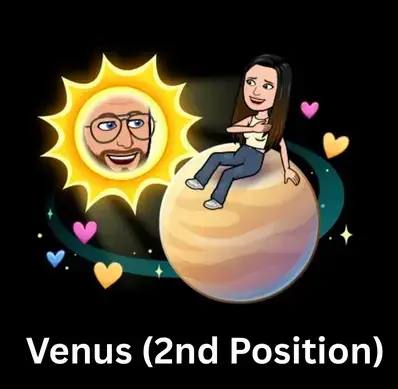
Venus (2nd Position)
Venus is the second planet in the Snapchat Friend Solar System and represents your second closest friend on the app. This position is assigned to someone with whom you maintain frequent communication, exchange regular snaps, and share ongoing conversations. While they may not hold the top Mercury spot, they remain one of your strongest and most active connections. Venus is typically displayed as a warm yellow or beige-colored planet surrounded by colorful hearts and sparkles, making it easy to recognize within the solar system.
A Venus ranking reflects a meaningful friendship built on consistent interaction and engagement. Users in this position often share important moments, react to stories, maintain streaks, and stay connected through daily chats. The planet symbolizes a trusted bond that remains strong over time, highlighting a friend who plays a significant role in your Snapchat experience and social circle.
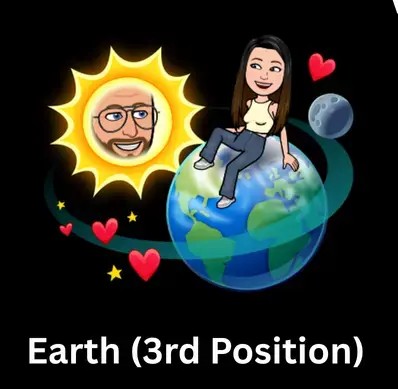
Earth (3rd Position)
Earth is the third planet in the Snapchat Friend Solar System and represents your third closest friend based on overall interaction and engagement. If someone appears as Earth, it means they are an important part of your Snapchat circle, with whom you regularly exchange snaps, messages, and story interactions. Although this friendship may not be as active as Mercury or Venus, it still reflects a strong and reliable connection built through consistent communication.
Visually, Earth resembles the real planet with recognizable land and ocean patterns, often accompanied by a moon, hearts, and sparkling stars. This position highlights a friendship that balances quality and consistency, where meaningful conversations and ongoing engagement keep the bond strong. Being ranked as Earth indicates that you remain among a person’s closest connections and play a significant role in their Snapchat Friend Solar System.
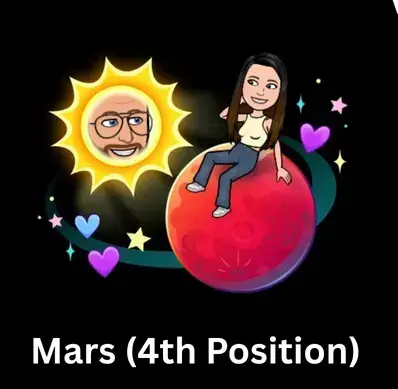
Mars (4th Position)
On Snapchat, Mars marks your 4th best friend, showing that while there may be fewer interactions than with the inner planets, the bond remains strong. This orange planet has a background filled with blue and purple hearts gently floating, as it displays your friend Bitmoji in a unique way.
If you are assigned to Mars, you probably snap and talk a couple of times each week, keeping the discussions light yet enjoyable whenever they take place. Still, when compared to the inner circle, the chats are less lengthy and not as in-depth, but they carry meaning in every conversation.
Jupiter (5th Position)
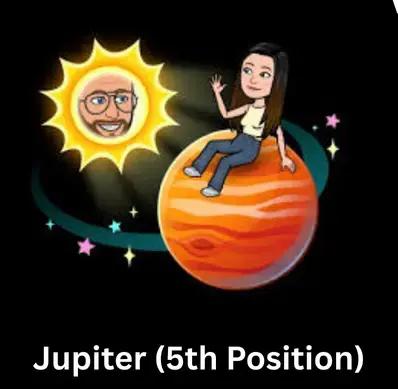
Jupiter is the fifth planet in the Snapchat Friend Solar System and represents your fifth closest friend based on overall interaction and engagement. At this level, communication is generally less frequent than with the top four planets, but the friendship remains active enough to secure a place in your top eight connections. Users assigned to Jupiter may exchange snaps, messages, and story reactions occasionally rather than on a daily basis.
Visually, Jupiter appears as a large orange planet featuring distinctive bands, rings, and soft-colored stars that make it stand out in the Snapchat Solar System. This position often reflects a dependable friendship where regular contact is not necessary to maintain the connection. Although interactions may happen weekly or from time to time, the relationship remains meaningful, trusted, and important enough to stay among your closest Snapchat friends.
Saturn (6th Position)
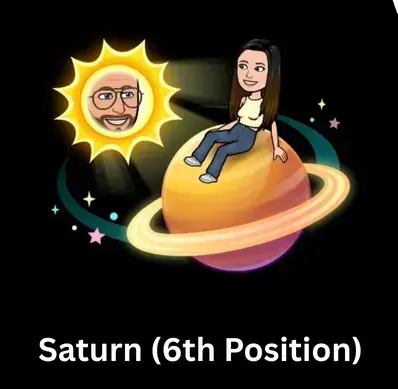
Saturn is the sixth planet in the Snapchat Friend Solar System and represents your sixth closest friend based on recent interaction levels. At this stage, communication is usually less frequent compared to higher-ranked planets, but the friendship remains significant enough to stay within your top eight connections. Users assigned to Saturn may exchange snaps, messages, or story reactions occasionally rather than maintaining daily conversations or long streaks.
Visually, Saturn appears as a yellow or golden planet with its iconic rings, accompanied by stars and a Bitmoji positioned nearby. Unlike the inner planets, Saturn typically features fewer heart-themed elements, reflecting a lower level of engagement. This position often represents a friendship that remains valuable despite reduced activity, showing that meaningful connections can continue even when communication becomes less regular over time.
Uranus (Seventh Position)
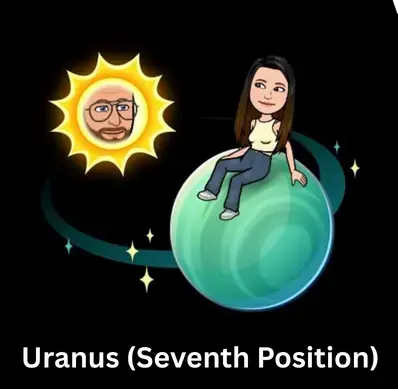
When someone is your 7th best Snapchat friend, it means you have been displaced to Uranus. On this far-off, cold planet, the interactions are minimal, and the bond does not feel as strong as it once did. The greenish design with only a Bitmoji and no hearts or extra decorations makes it clear that your connection has shifted.
In the Solar System design, Uranus is shown with a cool Blue-Green tone, symbolizing a distant but still recognized connection. Being placed here adoes not mean the friendship is weak, it simply shows that other friends are more active in your chats and snaps. For many users, Uranus feels like the start of the “outer planets” where bonds are meaningful but less intense.
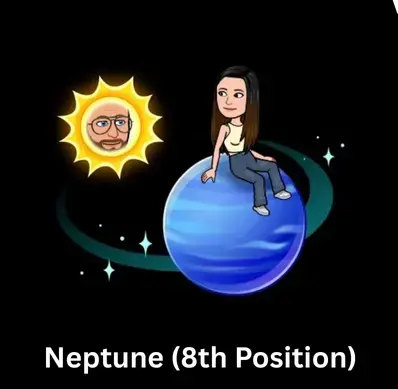
Neptune (8th Position)
Neptune is the eighth and final planet in the Snapchat Friend Solar System, representing your eighth closest friend based on recent interaction activity. While this friend still remains in your top eight connections, communication is usually limited compared to the higher-ranked planets. Interactions may include occasional snaps, story views, or brief conversations, but overall engagement is lower than with the rest of your closest friends.
Visually, Neptune appears as a deep blue planet decorated with subtle stars and space-themed effects, reflecting its position as the farthest planet from the Sun. This ranking does not mean the friendship is unimportant; instead, it indicates that other friends currently receive more frequent interaction. Neptune often represents a connection that remains recognized and valued but requires more engagement to move higher in the Snapchat Planets order. As interaction levels change over time, a Neptune friendship can still climb closer to the inner planets through consistent communication and activity.
Features of Snapchat Planets
Snapchat Planets offers a range of interactive and visually engaging features forSnapchat+ users, enhancing the Friend Solar System experience with augmented reality and creative design elements. Using Snapchat’s AR technology, the planets appear as dynamic 3D objects that can float and interact with real-world surroundings, creating a more immersive and lifelike experience. Users can control and adjust the display through simple touch gestures such as swiping, pinching, or rotating, allowing them to change the size, movement, and orientation of the planets for a more personalized view.
Features of Snapchat Planets (Step-by-Step)
Augmented Reality (AR) Experience
Snapchat Planets uses AR technology to make planets appear in real-world environments, creating an interactive and immersive solar system effect.
Interactive Controls
Users can control the planets using simple gestures like swiping, pinching, or rotating to change size, movement, and direction.
Dynamic Visual Effects
The feature includes glowing stars, animated rings, smooth transitions, and other effects that make the solar system visually engaging.
Customization Options
Users can personalize their planets by adjusting colors, textures, and styles to create a unique and customized experience.
Sharing on Snapchat
After customizing or interacting with the planets, users can share them directly through Snaps or Stories to engage friends in a creative way.
.
Snapchat Planets Order & Meaning (Step-by-Step)
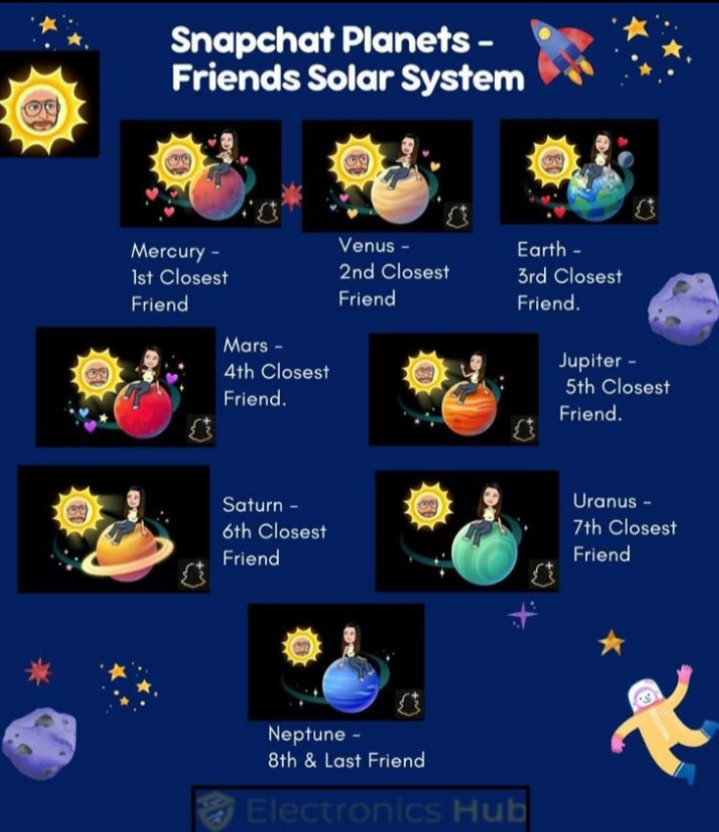
Mercury (1st Closest Friend)
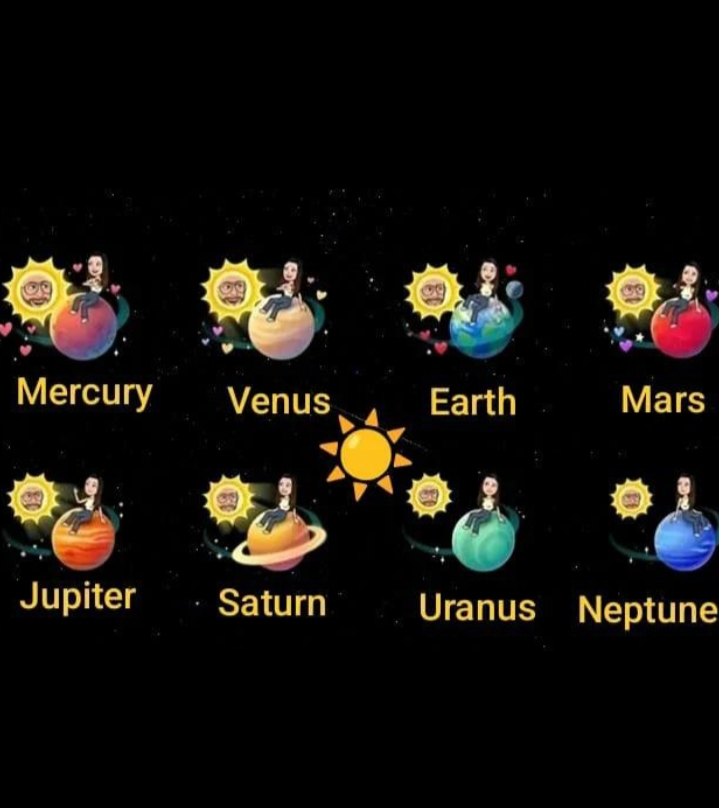
Mercury is the closest planet and represents your #1 best friend on Snapchat. It is shown as a red-colored planet with red hearts, symbolizing the strongest interaction and highest engagement in your solar system.
Venus (2nd Closest Friend)
Venus represents your second closest friend. It appears as a yellow planet with colorful hearts, showing a very strong and valued friendship based on frequent communication.
Earth (3rd Closest Friend)
Earth shows your third closest friend and is designed like the real Earth with a moon and hearts around it. It indicates a trusted and consistent friendship.
: Mars (4th Closest Friend)
Mars represents your fourth closest friend. It is a red planet with hearts and stars, showing moderate but still active interaction.
Jupiter (5th Closest Friend)
Jupiter is an orange planet with stars and represents your fifth closest friend. From this level onward, hearts disappear and only star effects are used.
Saturn (6th Closest Friend)
Saturn appears with its signature wide ring and represents your sixth closest friend, indicating a stable but less frequent interaction.
Uranus (7th Closest Friend)
Uranus is shown as a green planet and represents your seventh closest friend, showing lower interaction compared to higher-ranked friends.
Neptune (8th Closest Friend)
Neptune is the farthest planet in the system and represents your eighth closest friend, indicating the least interaction among your top 8 friends.
Snapchat Planets Order Explained (Mercury to Neptune)
The Snapchat Friend Solar System follows the same order as the real solar system, using planets to represent your top eight friends based on interaction levels. In this feature, you are the Sun, while your closest friends are assigned planets ranging from Mercury to Neptune. The friend you interact with the most through snaps, chats, streaks, and story engagement is represented by Mercury, while the remaining friends are ranked in order according to their activity level. As engagement decreases, the assigned planet moves farther from the Sun, with Neptune representing the eighth closest friend.
Understanding the Snapchat Planets order makes it easier to see where you stand in someone’s friendship ranking. Each planet has a unique appearance, color, and visual design that helps identify its position within the solar system. By viewing your planet placement, Snapchat+ users can quickly understand their strongest connections and track how interaction patterns influence friendship rankings over time.
Snap Planets Explained: How Snapchat Plus Ranks Your Best Friends
Snap Planets is a feature in Snapchat Plus that turns your closest friends into planets within a virtual solar system. Each planet represents a friend’s position in your Best Friends list, based on how often you interact with them. Understanding Snap Planets helps users see their friendship rankings and make the most of their Snapchat experience.
Snapchat vs Snapchat Plus Features
| Feature | Snapchat (Free Version) | Snapchat+ (Paid Version) |
| Cost | Free for all users | Paid subscription (monthly or yearly) |
| Best Friends System | Simple text-based list | Snapchat Planets (Solar System friendship ranking) |
| Customization | Limited options | App icons, chat wallpapers, profile badges |
| Exclusive Tools | Basic features like Snap Map, Streaks, Stories | Advanced features like Ghost Trails, priority replies, experimental tools |
| Friendship Insight | Basic interaction-based list | Detailed friendship insights with planet positions and badges |
hexrgba
Tips to Increase Your Snapchat Planets Ranking
Snap Frequently
Send snaps regularly to your friend to increase interaction and move your planet closer in their solar system.
Reply Quickly
Responding fast to messages and snaps helps maintain active engagement and improves your friendship ranking.
Start Conversations First
Initiate chats and send snaps before your friend does, as proactive communication boosts interaction levels.
Share Stories
Posting and interacting with stories increases visibility and strengthens your overall engagement score.
Use Bitmoji Creatively
Using Bitmoji in snaps makes conversations more fun and increases the chances of receiving replies.
Stay Consistent
Regular daily interaction is the key factor in maintaining or improving your position in Snapchat Planets over time.
Difference Between Friends and Best Friends on Snapchat
On Snapchat, not all connections carry the same level of interaction. A Friends badge simply indicates that you are connected with someone, but it usually reflects casual or low-level engagement without strong communication. On the other hand, a Best Friends badge represents a higher level of interaction, where users frequently exchange snaps, chats, and maintain consistent communication over time. For Snapchat+ users, this relationship becomes even more advanced through the Friend Solar System, where Best Friends are displayed as planets orbiting the Sun and ranked according to interaction frequency.
| Feature | Friends | Best Friends |
| Badge Meaning | Casual connection | Strong and frequent interaction |
| Visibility | Shown for general contacts | Limited to top active friends |
| Solar System Role | Not included | Represented as planets around the Sun |
| Ranking System | No ranking | Ranked by snaps, chats, and engagement |
What is Snapchat+?
Snapchat+ is a premium subscription service that enhances the standard Snapchat experience by offering exclusive features and deeper customization options. It includes benefits such as personalized app icons, priority story replies, experimental tools, premium filters, and advanced tracking features like Ghost Trails and friendship insights. One of its most popular features is the Friend Solar System, which visually represents your closest friends as planets based on interaction levels.
With Snapchat+, users get a more personalized and interactive experience that focuses on creativity, engagement, and social connection. It is a paid service available on a monthly or yearly basis, giving subscribers access to all premium tools and features not available in the free version.
Snapchat Plus Subscription: Details & Pricing
Snapchat Plus is a premium subscription service that enhances the standard Snapchat experience by unlocking exclusive features such as the Friend Solar System, custom app icons, story rewatch counts, and early access to experimental tools. While the free version of Snapchat offers basic communication features, Snapchat+ provides deeper friendship insights, personalization options, and additional control over how users interact within the app. It is an optional upgrade designed for users who want a more advanced and engaging social experience.
Snapchat Plus Pricing (By Country)
| Country | Monthly Plan | 4 Months | 6 Months | Yearly Plan |
| United States | $3.99 | $15.96 | $23.94 | $47.88 |
| United Kingdom | £3.99 | £15.96 | £23.94 | £47.88 |
| Pakistan | Rs110 | Rs440 | Rs660 | Rs1100 |
Key Difference: Free vs Snapchat+
| Feature | Snapchat (Free Version) | Snapchat Plus |
| Cost | Free | Paid subscription (monthly/yearly) |
| Friend Solar System | Not available | Included |
| Best Friends Badge | Basic view | Enhanced with planet ranking |
| Customization | Limited options | Icons, themes, experimental tools |
| Story Insights | Basic viewing | Story rewatch count & analytics |
| Access Level | Standard features | Priority + early access features |
Frequently Asked Questions (FAQs) – Snapchat Planets
Conclusion
Snapchat Planets is a creative Snapchat+ feature that turns your friendships into a visual solar system, where Mercury represents your closest friend and Neptune shows the most distant among your top eight connections. Each planet, color, and Bitmoji reflects your interaction level, making it easier to understand how you connect with different people based on snaps, chats, streaks, and engagement activity. This feature adds a playful yet meaningful layer to social interaction by combining real communication data with an engaging space-themed design.
Beyond entertainment, Snapchat Planets also encourages stronger and more consistent communication with friends. As your activity increases, your planet ranking can improve, showing closer placement in someone’s solar system. With Snapchat+, users also get enhanced customization and deeper insights into friendships, making the experience more interactive and personalized. Overall, this feature not only visualizes social connections but also motivates users to stay engaged and maintain meaningful relationships on the plants.